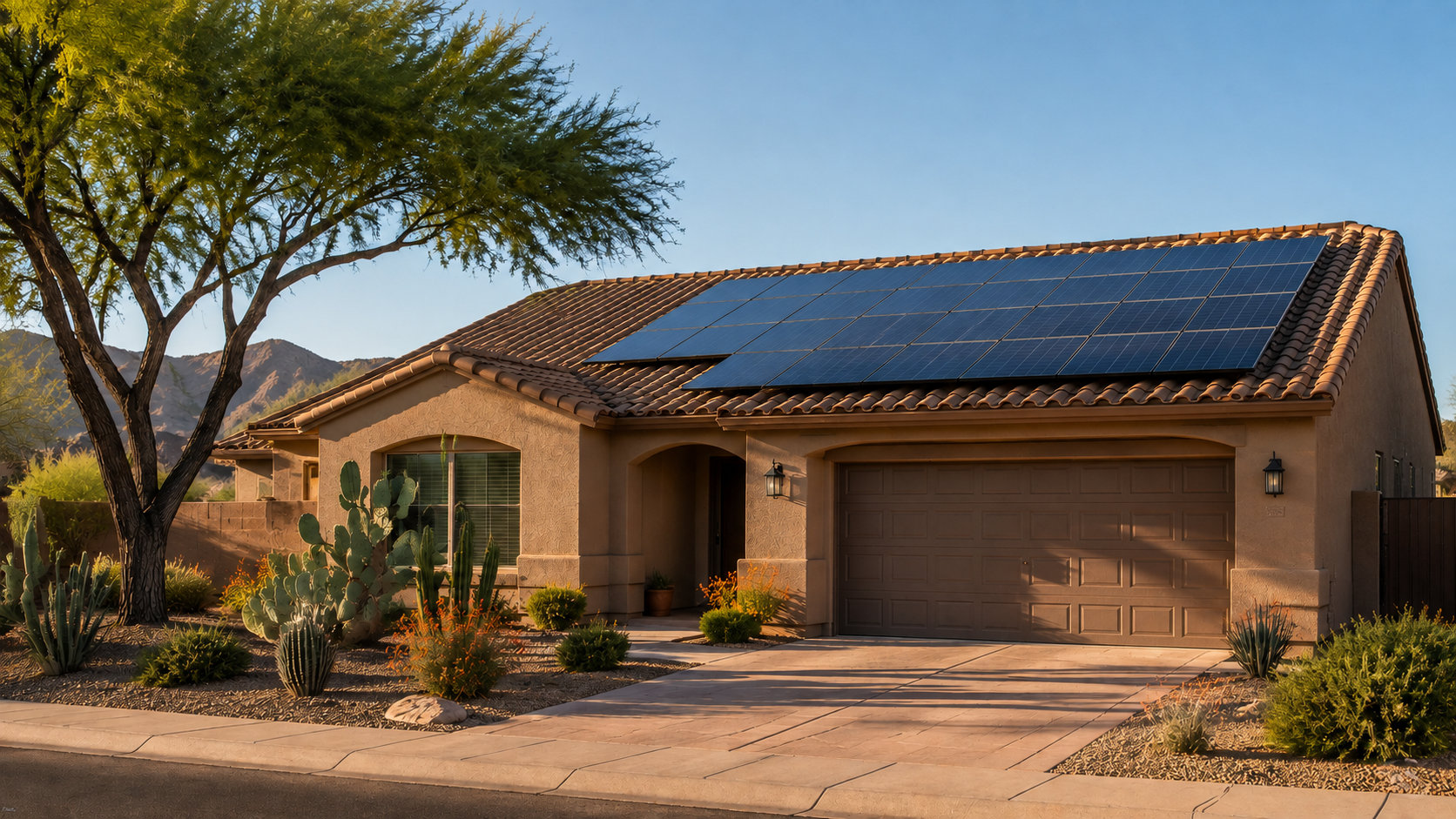
You can sell a house with solar panels in Arizona. The key is understanding who owns the system, what obligations remain, how the agreement handles a sale, and what the buyer’s lender and title company will require.
Solar is not one category. An owned system, a financed purchase, a lease, and a power purchase agreement can create very different transaction steps. Starting early gives the seller time to gather documents and resolve questions before an offer is under deadline.
First identify how the solar system is owned
Find the original agreement and determine which of these situations applies:
- Owned free and clear: The homeowner owns the equipment with no remaining solar debt.
- Financed purchase: The homeowner owns or is purchasing the system, but a loan or other obligation remains.
- Lease: A solar company owns the equipment and the homeowner pays under a lease.
- Power purchase agreement: A third party owns the system and the homeowner pays for energy under the agreement.
Do not rely only on a monthly utility statement. The contract, current payoff or transfer information, title records, and system ownership documents provide the details needed for the sale.
Owned solar is usually the clearest situation
When the system is owned free and clear, the seller can generally transfer the home and equipment together, subject to the contract, title, appraisal, and other transaction requirements. Buyers may still ask about installation date, production, warranties, inverter or battery equipment, roof work, permits, and maintenance.
Owned solar does not guarantee a specific increase in value. Appraisers and buyers consider market evidence, system condition, energy contribution, ownership, remaining useful life, and comparable sales.
A financed system needs a payoff and lien review
If a loan remains, determine whether it must be paid at or before closing, can be assumed, or follows another process. Ask the provider for a current payoff and written sale instructions. Confirm whether any UCC filing, fixture filing, or lien affects the real property, the equipment, or both.
Do not advertise a system as “paid off at closing” until the expected payoff and net proceeds have been reviewed. The payoff may be different from the equipment’s original price or the balance shown on a recent statement.
Leases and PPAs require transfer planning
A lease or power purchase agreement may require the buyer to qualify, sign transfer documents, accept payment terms, or complete other provider steps. The seller should request the current transfer package before listing so those requirements can be explained accurately.
Fannie Mae’s current Selling Guide requires lenders to review a lease or power purchase agreement on applicable loans. It also addresses how payments, appraised value, title filings, insurance, and access to electrical utilities are treated. Freddie Mac likewise distinguishes among PPAs, leases, financed systems, and systems owned free and clear.
The buyer’s lender must evaluate the actual agreement. A transaction can be delayed when solar documents arrive late or the parties make assumptions about transferability.
Gather the complete solar file
A useful seller file may include:
- Original purchase, loan, lease, or PPA agreement
- Current payoff or transfer instructions
- Recent billing and production information
- Equipment list and installation date
- Warranty and service documents
- Permit and inspection records when available
- Roof and panel removal records
- Battery documentation, if applicable
- Provider contact information and processing timelines
Accurate records make it easier for the buyer, lender, appraiser, title company, and escrow team to understand the system.
Explain benefits without promising savings
Energy use, utility rates, rate plans, system production, shade, orientation, equipment performance, and household behavior all affect a utility bill. A seller should not promise that the buyer will receive the same savings.
Provide historical information with appropriate context. Avoid presenting a limited billing period as a guaranteed future result. If the system has monitoring reports, explain what they cover and let the buyer conduct their own review.
Review the roof before marketing the system
Roof age and condition matter because future roof work may require panel removal and reinstallation. Buyers may ask who is authorized to perform that work, what it costs, and whether it affects roof or solar warranties.
If the roof has a known issue, coordinate the investigation with the solar agreement rather than treating them as unrelated projects. The guide to replacing a roof before selling an Arizona home explains the broader repair decision.
Prepare for buyer financing and appraisal questions
Solar ownership can affect underwriting and valuation. Third-party-owned systems may not be included in value in the same way as owned equipment. Some payments may need to be included in the buyer’s debt-to-income analysis, depending on the agreement and loan requirements.
This is why the buyer should share the solar documents with the lender early. The listing agent can help organize information, but the lender decides how the loan program treats the obligation.
Compare payoff, transfer, and pricing options
A seller with a remaining obligation may consider paying it off, requiring the buyer to assume or transfer it when permitted, or structuring another approved solution. The right choice depends on contract terms, payoff amount, expected net proceeds, market response, and buyer financing.
Do not make a payoff decision without reviewing the likely home value and sale costs. Andrew’s home valuation can provide useful pricing context, and his Seller’s Agent Services include preparation, marketing, offer analysis, and transaction coordination.
Start before the home is under contract
The best time to solve a solar question is before it becomes a closing deadline. Identify ownership, request documents, review roof condition, and determine the provider’s transfer or payoff process before listing.
Talk with Andrew about how your solar agreement fits into the sale plan. He can help organize the real estate side of the transaction while the solar provider, lender, title company, and appropriate professionals address their specific requirements.
Sources reviewed
- Fannie Mae Selling Guide: Properties with solar panels
- Freddie Mac Guide Section 5601.4: Solar panels
This article is general real estate education, not legal, tax, lending, appraisal, solar, title, or utility advice. Review the actual agreement and obtain property-specific guidance.