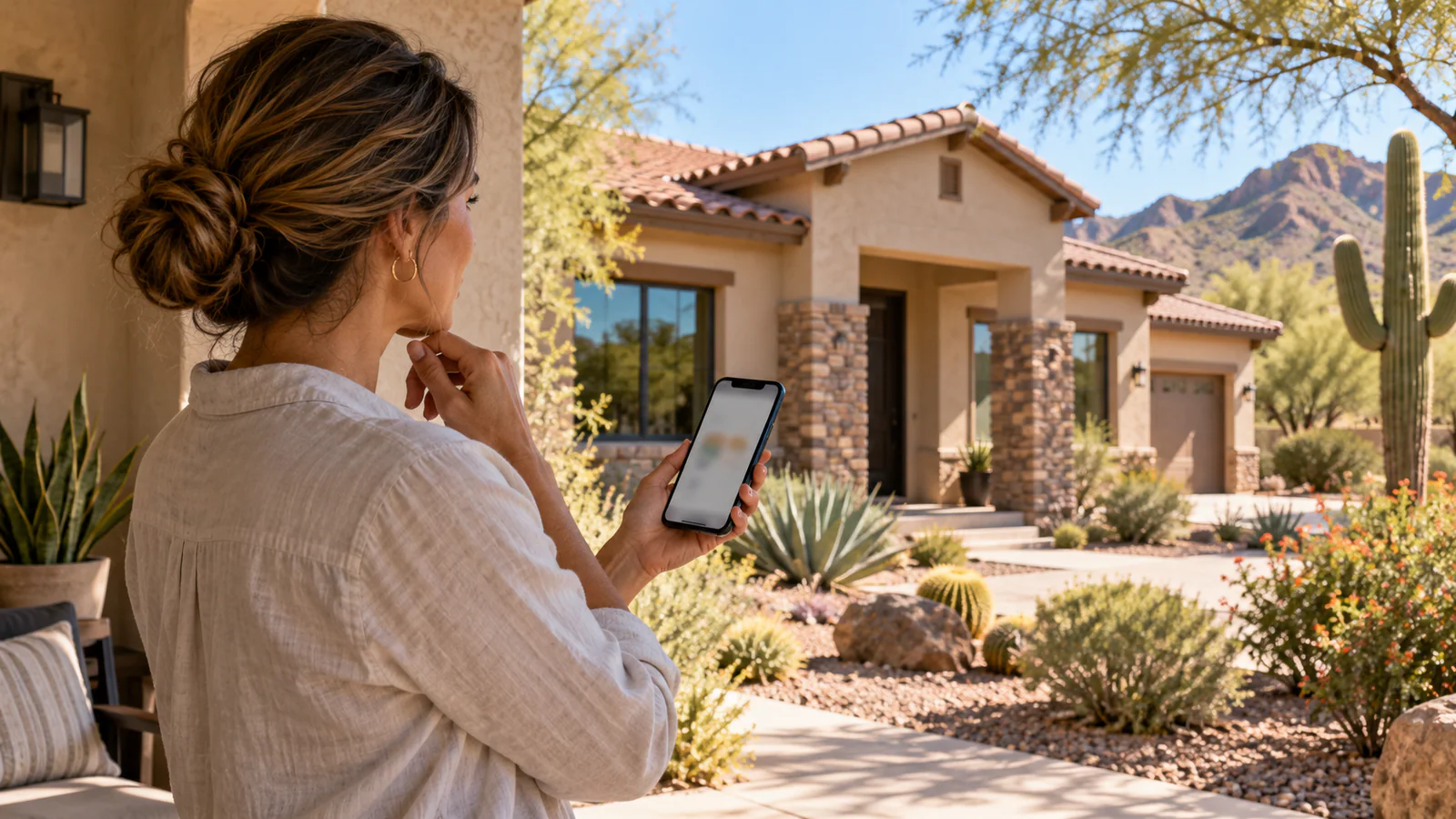
An online home estimate can be useful for a quick reference, but it is not a walk-through of your property and it is not a guaranteed sale price. The estimate is produced by an automated valuation model using the data and comparable sales available to that system.
Arizona homes can differ in ways that are difficult for an algorithm to see. Condition, renovations, lot placement, views, pools, solar agreements, neighborhood boundaries, and current competition can all change how buyers respond.
Automated estimates depend on available data
An automated valuation model compares property facts and market records through mathematical rules. The Consumer Financial Protection Bureau explains that an AVM can use details such as bedrooms, bathrooms, square footage, recent sales, and other market information.
If the underlying record is incomplete or wrong, the estimate may start with the wrong assumptions. Public records may not reflect an addition, renovation, converted space, removed pool, corrected square footage, or recent change in condition.
The model has not seen the inside of the home
Two homes with similar public facts can feel very different during a showing. One may have updated systems, consistent finishes, natural light, and careful maintenance. The other may need roof, cooling, flooring, paint, or major interior work.
An online tool may infer condition from previous listing information, but it usually cannot evaluate the home today with the detail of an in-person property review.
Renovations do not have one universal return
A remodeled kitchen can improve marketability, but the value depends on quality, design, age, functionality, and buyer expectations in that price range. The cost of the project does not automatically equal the amount buyers will add to an offer.
Algorithms may also miss renovations that were completed after the last public listing or treat all updates as equivalent. A professional analysis asks what was changed, when it was completed, how it compares with competing homes, and whether buyers in the segment are paying more for that feature.
Lot and view differences are easy to understate
A model may recognize lot size but not the full experience of the lot. Privacy, orientation, usable yard space, wash or open-space adjacency, mountain views, golf frontage, traffic exposure, and backing conditions can affect demand.
Even the same floor plan within one subdivision may sell differently because one location feels quieter or more private. Those differences need local context.
Pools require neighborhood context
A pool can be desirable in Arizona, but its contribution is not identical across the Phoenix metro. Condition, design, age, equipment, yard layout, price range, and the number of competing pool homes all matter.
An estimate can be wrong when it uses a fixed pool adjustment or selects comparable sales from a segment where buyers respond differently.
Solar can confuse the comparison
Owned solar, financed solar, leases, and power purchase agreements are not financially equivalent. A model may detect panels without knowing the ownership structure, remaining obligation, equipment age, production, or relationship to the roof.
Buyers and lenders may evaluate each arrangement differently. The article on selling an Arizona house with solar panels explains why documentation matters.
Neighborhood boundaries are not always obvious in the data
An automated search radius can cross a school boundary, municipality line, age-restricted community, gated entrance, tax area, HOA boundary, or development phase. Nearby sales are not always true substitutes.
A local valuation checks whether buyers would realistically compare the properties. Distance is useful, but market area and buyer behavior are more important.
Comparable selection can change the result
The CFPB notes that valuations may differ because they use different comparable sales, dates, and purposes. One model may prioritize proximity. Another may emphasize size or recency. A human reviewer can explain why a sale should be included, adjusted, or rejected.
Outlier sales also require context. A distressed property, unusual concession, major renovation, superior lot, or private sale may not represent the typical market response.
Fast-moving conditions can outpace the estimate
Closed sales look backward. Active listings, new competition, price reductions, buyer activity, financing conditions, and pending sales help show what is happening now.
An automated estimate may update frequently but still rely on older closed data. This matters when supply and demand are changing within a specific price range or community.
An online estimate and an appraisal serve different purposes
An online estimate is not the same as an appraisal or a broker price opinion. A licensed appraiser develops an independent valuation for a defined assignment. A real estate professional analyzes likely market response and pricing strategy. An AVM produces a computer-generated estimate from available inputs.
These values can differ without one simple calculation error because the tools use different information, methods, timing, and purposes.
Use the estimate as a question, not the answer
An online value can help start a conversation. Ask:
- Which comparable sales appear to support it?
- Does the system have the correct property facts?
- Does it reflect current condition and upgrades?
- Did it cross an important neighborhood boundary?
- How does the home compare with active competition?
- What price range is supported after an in-person review?
Get a valuation that explains the evidence
Andrew’s professional Arizona home valuation reviews the property, relevant comparable sales, active competition, and local market context. You receive more than a number. You receive the reasoning needed to plan preparation and pricing.
If you are considering a sale, talk with Andrew about the condition and features an automated tool may have missed. His Seller’s Agent Services connect valuation with preparation, marketing, offer analysis, and negotiation.
Sources reviewed
- Consumer Financial Protection Bureau: Types of valuations
- Federal Housing Finance Agency: AVM quality-control standards
This article is general real estate education. Automated estimates, market analyses, and appraisals are opinions based on available information and do not guarantee a sale price.